# Bulwark Webmail
A modern, self-hosted webmail client for [Stalwart Mail Server](https://stalw.art/), built with Next.js and the JMAP protocol.
[](LICENSE)
[](https://discord.gg/tYCujymGrT)
[](CHANGELOG.md)
[](https://ghcr.io/bulwarkmail/webmail)
---
## Installer
New in **1.6.4**: a web-based setup wizard runs on first launch – no `.env.local` editing, no shelling into the container.
Point a browser at the running container and the wizard guides you through:
- **Server** – probe one or more JMAP endpoints, optional auto-pick by email domain, Stalwart feature toggle
- **Auth** – OAuth2 / OIDC discovery and validation, or basic-auth fallback
- **Security** – generate or paste a `SESSION_SECRET`, opt into settings sync
- **Logging** – text or JSON, level
- **Branding** – upload favicon, app logos, login logos, and company / legal URLs
- **Review** – grouped summary with an advanced toggle for the full config
- **Admin** – set the initial admin password and optionally drop a `.config-locked` marker so the config volume can be remounted read-only
The wizard writes to `ADMIN_CONFIG_DIR` (`./data/admin` by default). Setting `JMAP_SERVER_URL` in the environment skips the wizard and uses env-managed configuration instead.
---
## Screenshots
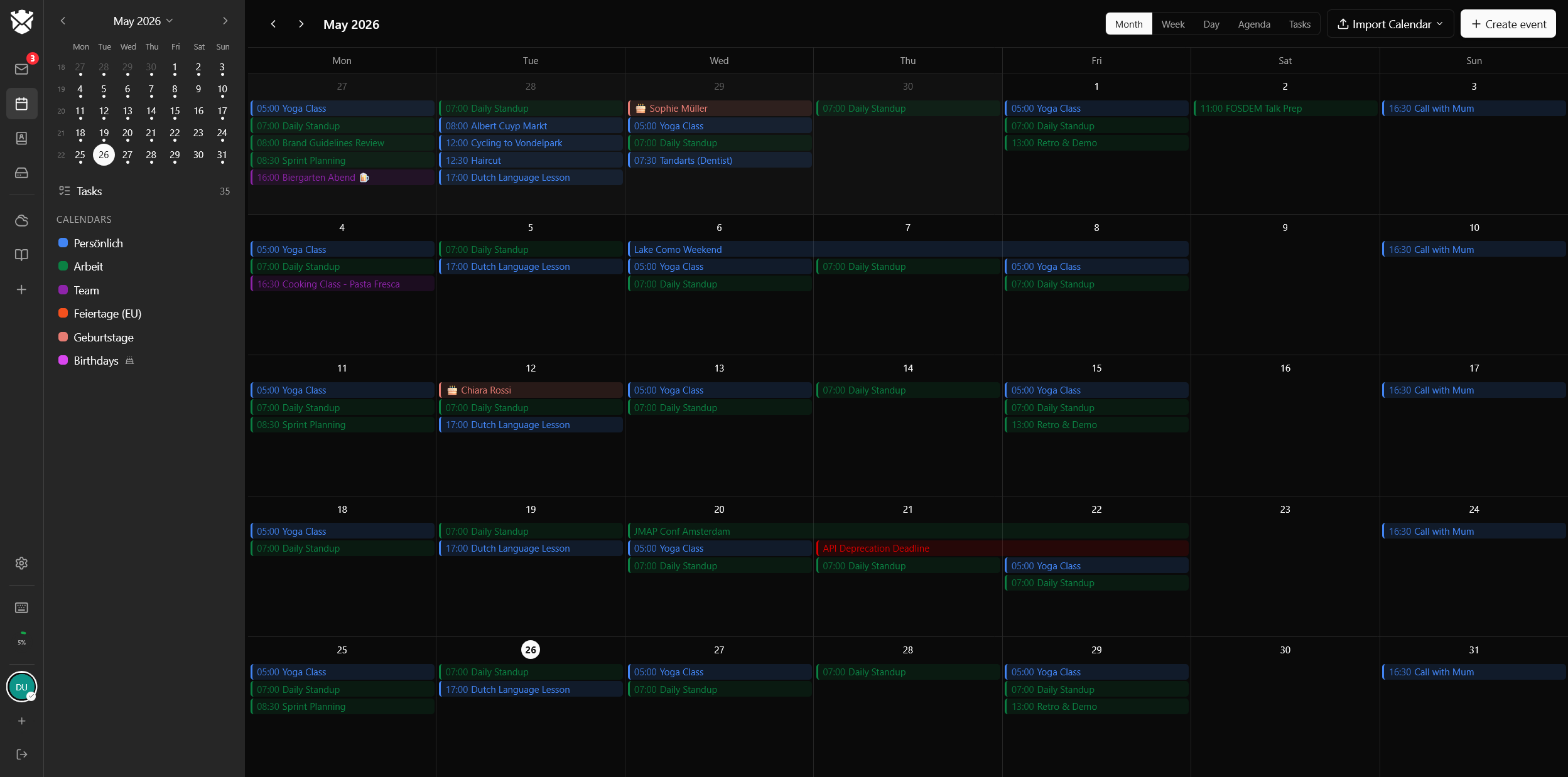
Calendar – month, week, day, and agenda views with drag-to-reschedule, iMIP invitations, and CalDAV subscriptions.
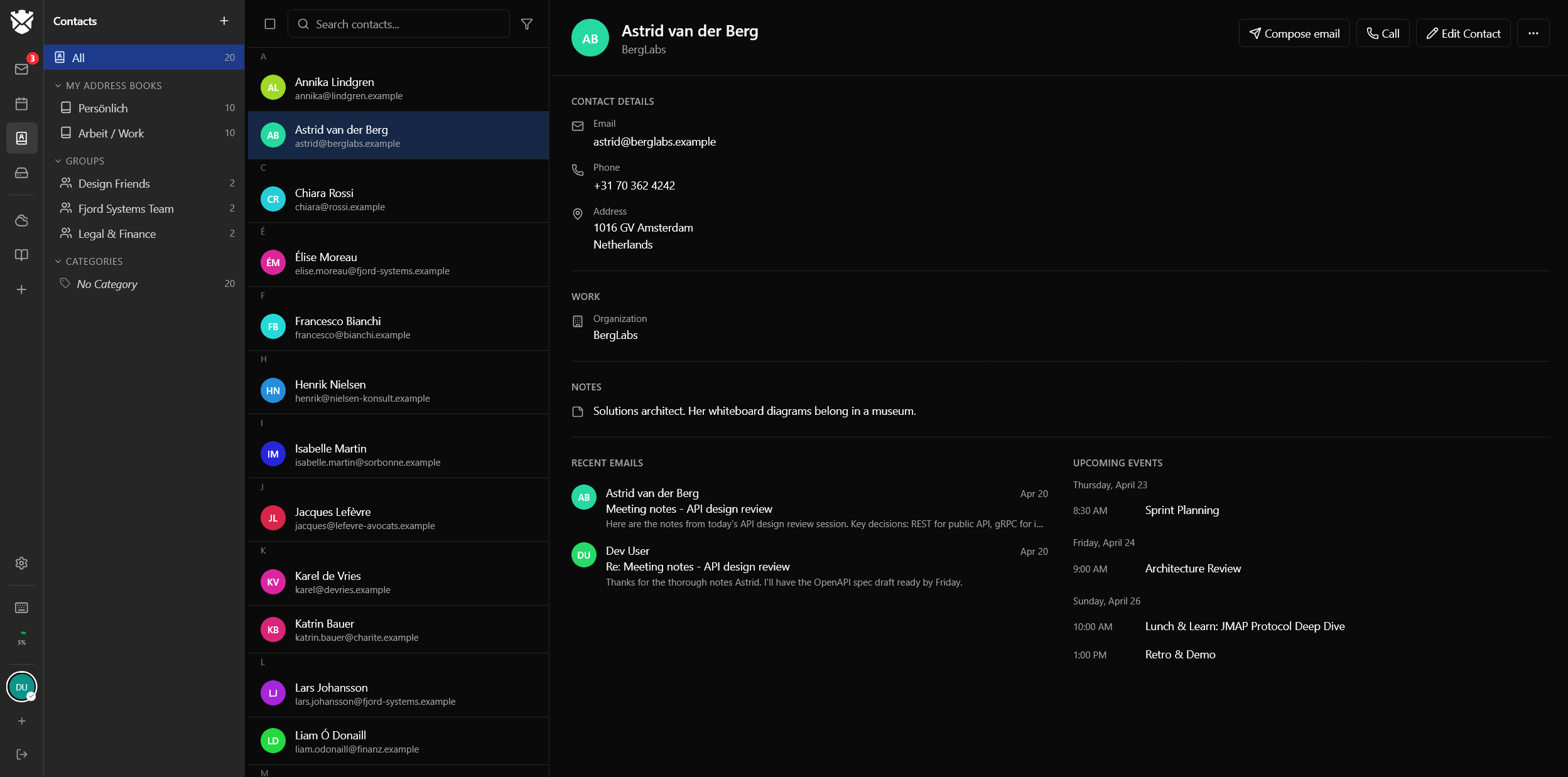
Contacts – multiple address books, groups, vCard import/export, and autocomplete in the composer.
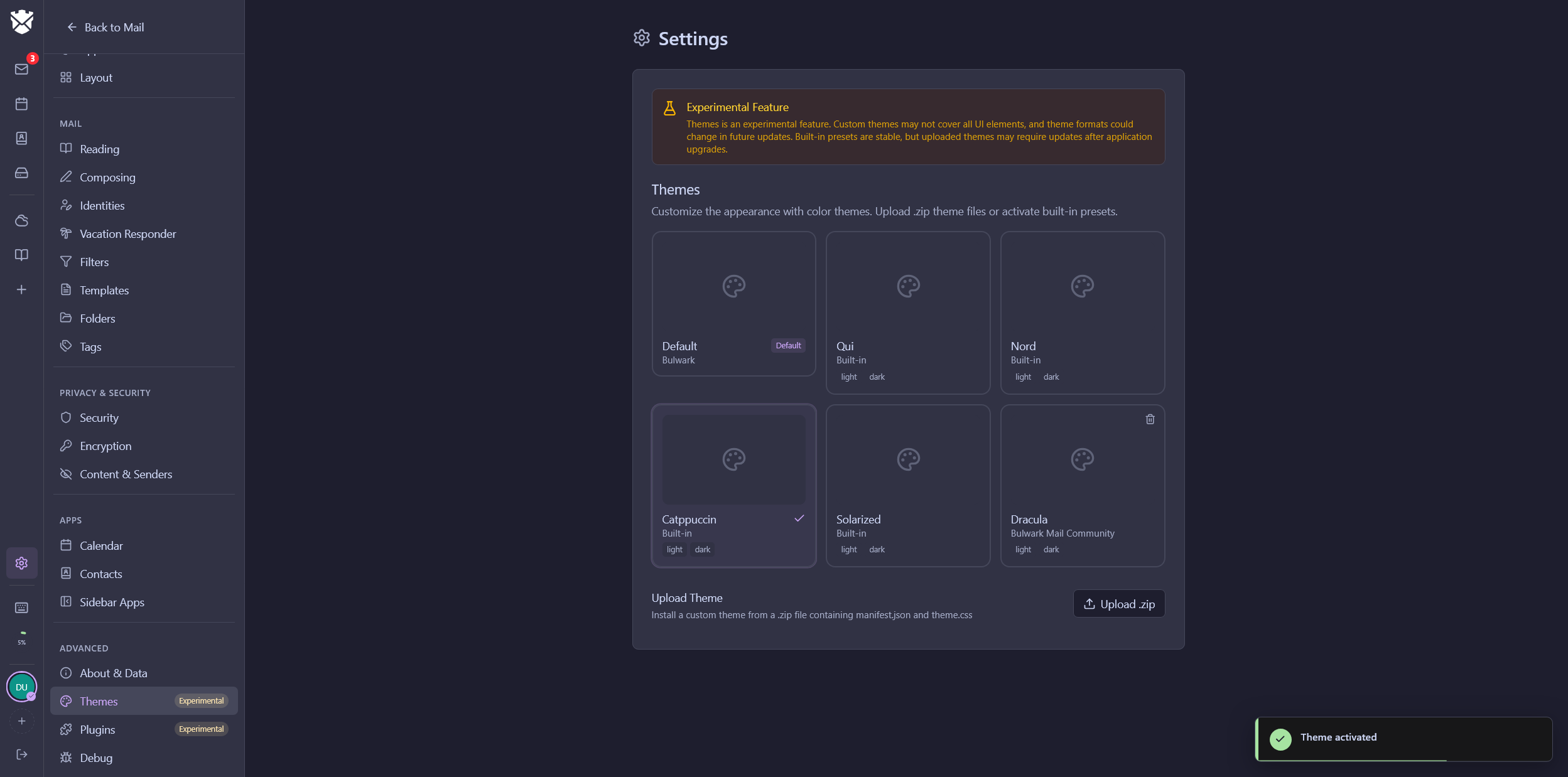
Themes – bundled color themes or upload your own as ZIP bundles; admins can enforce presets.
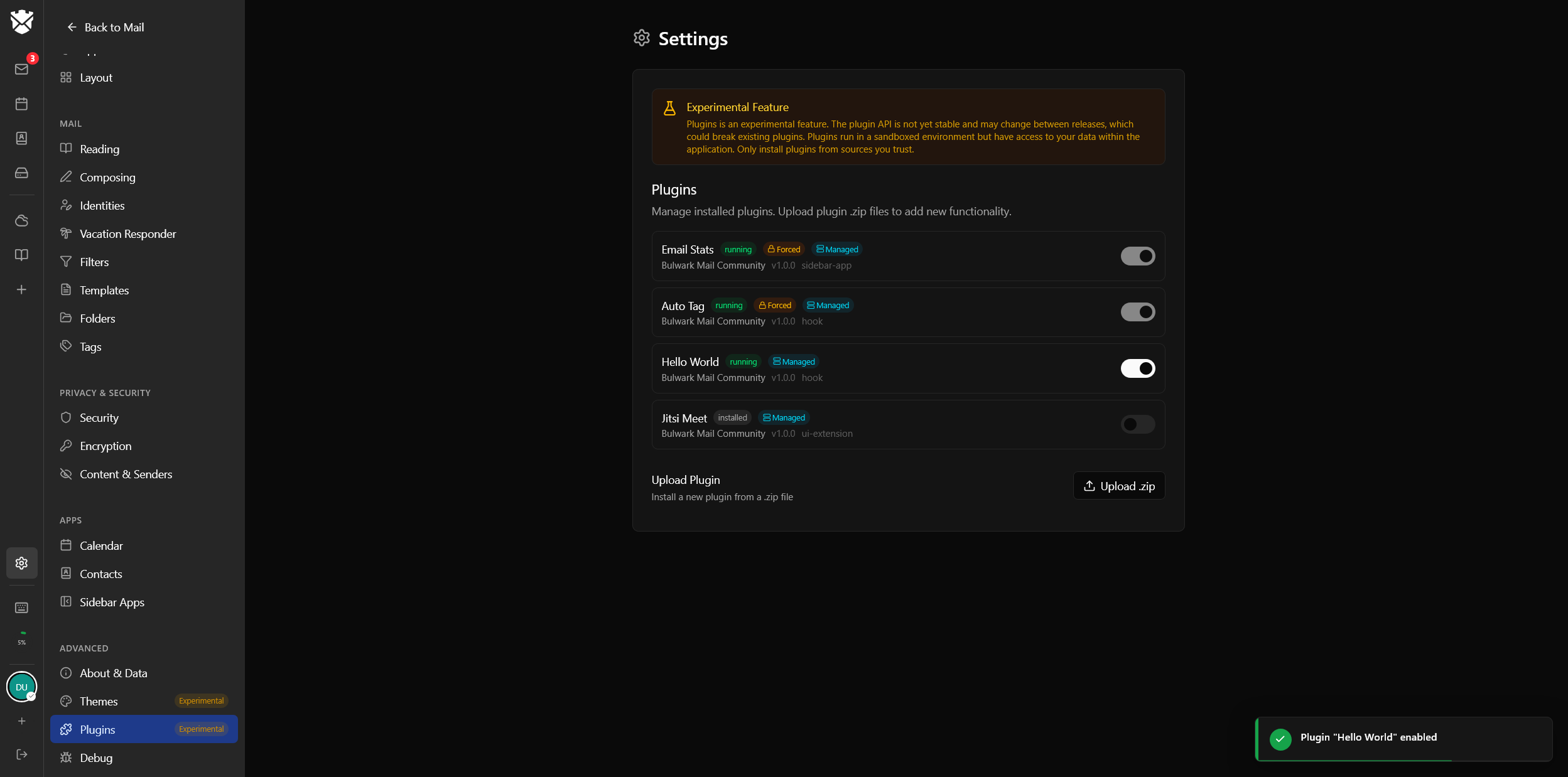
Plugins – extend the client with bundled or third-party plugins installed from a .zip file.
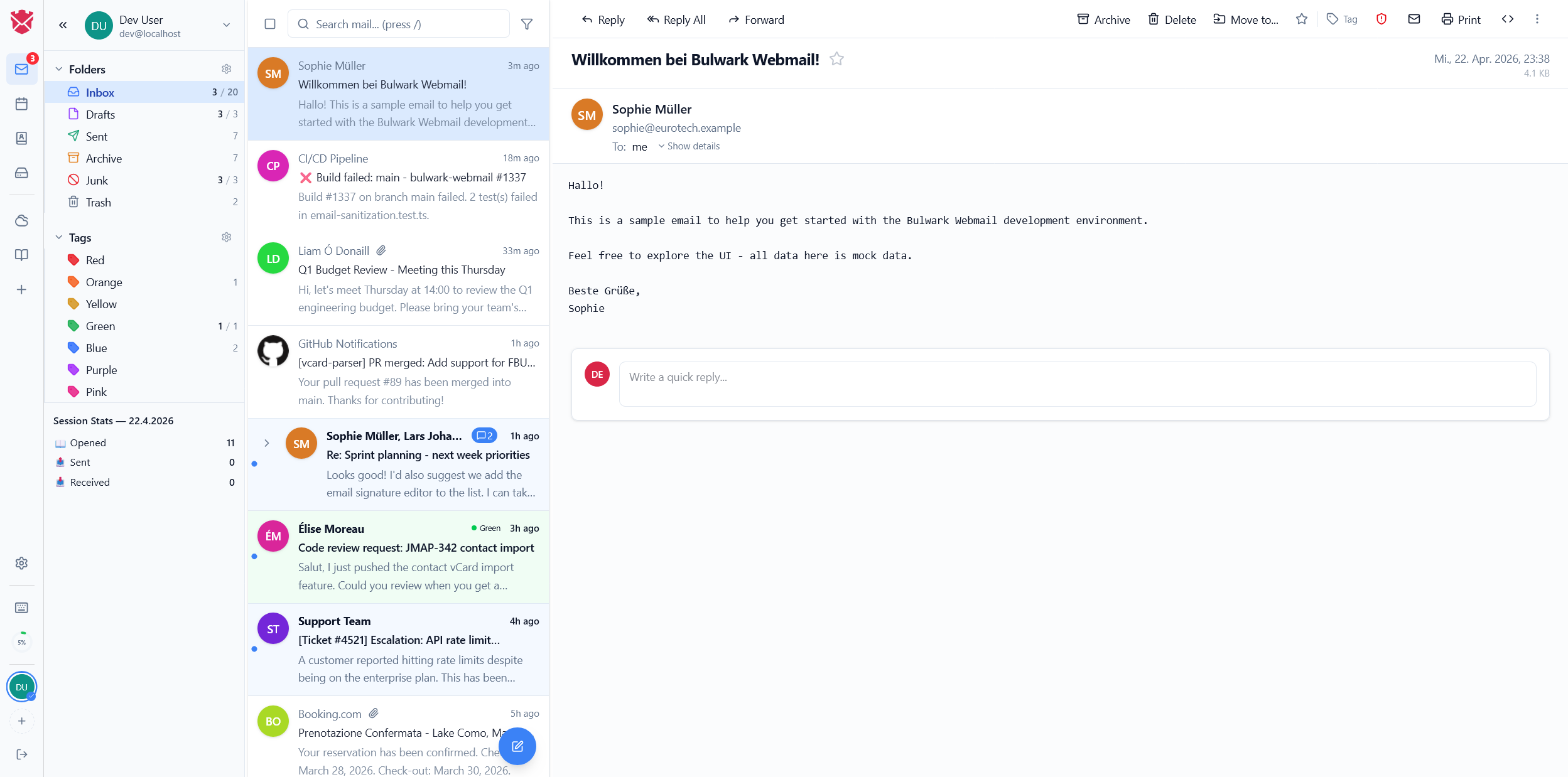
Light mode – full theme support with intelligent color transformation for HTML emails.
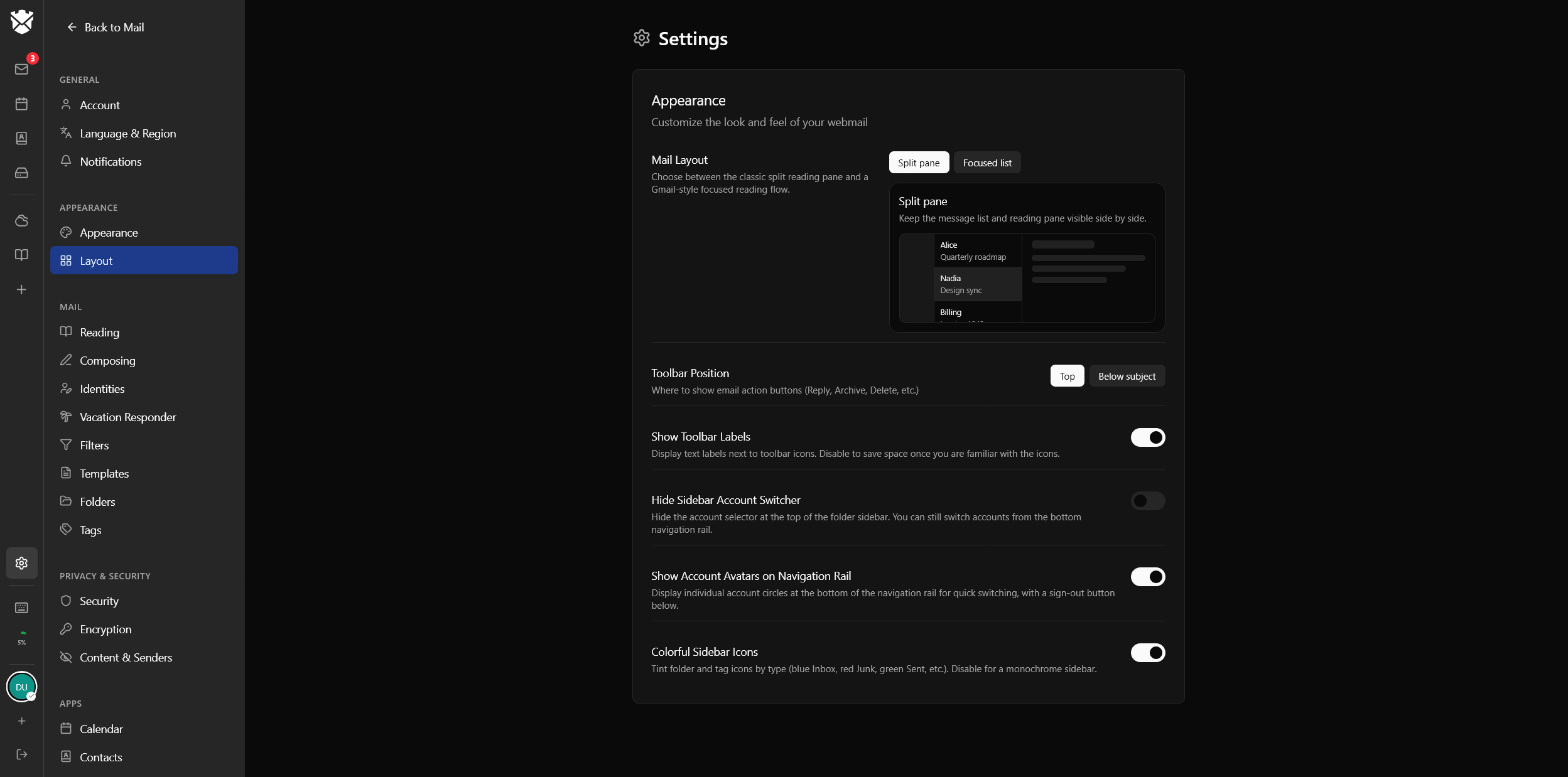
Settings – appearance, identities, filters, templates, security, and more.
## Overview
Bulwark is a full webmail suite, not just an inbox. It bundles the four apps most self-hosters end up wanting on the same login:
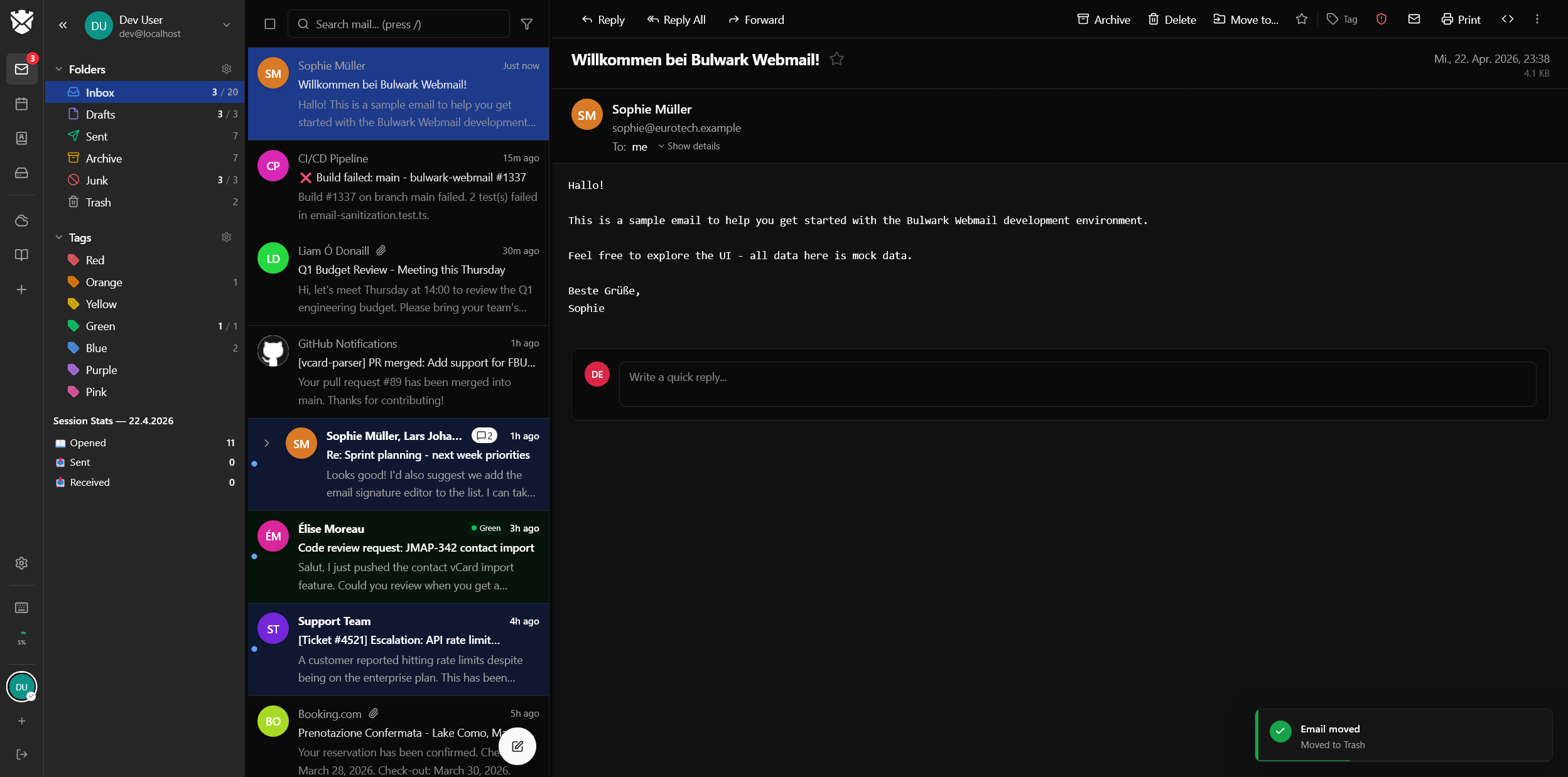
- **Mail** – threading, unified inbox, cross-account "All accounts" views, full-text search, Sieve filters, S/MIME, templates
- **Calendar** – month/week/day/agenda, recurring events, iMIP invitations, CalDAV subscriptions
- **Contacts** – multiple address books, groups, vCard import/export
- **Files** – Stalwart's JMAP FileNode storage with previews and folder upload
Plus the infrastructure around them: a web setup wizard, OAuth2 / OIDC SSO, TOTP 2FA, multi-account with HTTP/2 connection pooling, 18 languages, PWA install, dark/light themes, a plugin system with an extension marketplace, and an admin dashboard.
Full feature list: **[FEATURES.md](FEATURES.md)**.
---
## Quick Start
### Docker
```bash
docker run -d -p 3000:3000 ghcr.io/bulwarkmail/webmail:latest
```
Or with Docker Compose:
```bash
docker compose up -d
```
On first launch, open `http://localhost:3000` – the **web setup wizard** walks you through JMAP server, OAuth, branding, and the admin password. No `.env.local` editing required. Existing installs that already define `JMAP_SERVER_URL` in their environment skip the wizard and keep the env-managed flow described under [Configuration](#configuration).
### From Source
```bash
git clone https://github.com/bulwarkmail/webmail.git
cd webmail
npm install
npm run build && npm start
# Then open http://localhost:3000 to run the setup wizard
```
### Development
```bash
npm run dev # Dev server with a mock JMAP server
npm run typecheck
npm run lint
```
## Configuration
Most deployments are configured through the **setup wizard** (on first launch) and the **admin dashboard** thereafter; values are written to the admin config directory rather than `.env.local`. Environment variables remain supported for operators who prefer file-driven configuration or read-only / immutable infrastructure. When an environment variable is set, it takes precedence over the corresponding admin-managed value, so setting `JMAP_SERVER_URL` will hide that field from the wizard and lock it in the admin UI.
All variables are evaluated at runtime, so Docker deployments can be reconfigured without rebuilding. Edit `.env.local`:
```env
# Optional – overrides whatever the wizard writes
JMAP_SERVER_URL=https://mail.example.com
APP_NAME=My Webmail
```
Server listen address
```env
HOSTNAME=0.0.0.0 # Default; use "::" for IPv6
PORT=3000
```
OAuth2 / OIDC
```env
OAUTH_ENABLED=true
OAUTH_CLIENT_ID=webmail
OAUTH_CLIENT_SECRET= # optional, for confidential clients
OAUTH_CLIENT_SECRET_FILE= # path to a file containing the secret
OAUTH_ISSUER_URL= # optional, for external IdPs
```
Endpoints are auto-discovered via `.well-known/oauth-authorization-server` or `.well-known/openid-configuration`.
Session & settings sync
```env
SESSION_SECRET= # openssl rand -base64 32
SESSION_SECRET_FILE=/session-secret # path to a file containing the secret
SETTINGS_SYNC_ENABLED=true
SETTINGS_DATA_DIR=./data/settings # mount as a volume in Docker
```
Credentials are encrypted with AES-256-GCM and stored in an httpOnly cookie (30-day expiry). Settings sync stores per-account preferences encrypted at rest and requires `SESSION_SECRET`.
Custom JMAP endpoint
```env
ALLOW_CUSTOM_JMAP_ENDPOINT=true
```
Shows a "JMAP Server" field on the login form. External servers must CORS-allow the webmail origin.
Branding & PWA
```env
APP_NAME=My Webmail
APP_SHORT_NAME=Webmail
APP_DESCRIPTION=Your personal mail
FAVICON_URL=/branding/favicon.svg
PWA_ICON_URL=/branding/icon.svg # falls back to FAVICON_URL
PWA_THEME_COLOR=#3b82f6
PWA_BACKGROUND_COLOR=#ffffff
APP_LOGO_LIGHT_URL=/branding/logo-light.svg
APP_LOGO_DARK_URL=/branding/logo-dark.svg
LOGIN_LOGO_LIGHT_URL=/branding/login-light.svg
LOGIN_LOGO_DARK_URL=/branding/login-dark.svg
LOGIN_COMPANY_NAME=My Company
LOGIN_WEBSITE_URL=https://example.com
LOGIN_IMPRINT_URL=https://example.com/imprint
LOGIN_PRIVACY_POLICY_URL=https://example.com/privacy
# Per-domain overrides (optional). When the webmail is served on multiple
# hostnames, each host can override any subset of the branding fields above.
# Match is on the request Host (or X-Forwarded-Host). Use "*.example.com" to
# match any subdomain. Unset fields fall back to the global values.
DOMAIN_BRANDING=[{"host":"maildomain1.com","loginCompanyName":"Company One","loginLogoLightUrl":"/branding/one.svg"},{"host":"maildomain2.com","loginCompanyName":"Company Two"}]
```
Extension directory
```env
EXTENSION_DIRECTORY_URL=https://extensions.bulwarkmail.org
```
Enables the admin marketplace for browsing and installing plugins and themes.
Stalwart integration & logging
```env
STALWART_FEATURES=true # password change, Sieve filters, etc.
LOG_FORMAT=text # "text" or "json"
LOG_LEVEL=info # error | warn | info | debug
```
Admin data directories
```env
ADMIN_CONFIG_DIR=./data/admin # operator-authored: config.json, policy.json, plugins/, themes/
ADMIN_STATE_DIR=./data/admin-state # runtime: audit log, login timestamps, setup token
ADMIN_CONFIG_READONLY=true # enforce read-only mode at the app layer
```
The split lets you mount the config volume read-only after the setup wizard completes. Legacy installs that pre-date the split keep working through `ADMIN_DATA_DIR`.
Subpath / reverse proxy mount
To serve the webmail at a subpath (e.g. `https://example.com/webmail`):
```env
NEXT_PUBLIC_BASE_PATH=/webmail
NEXT_PUBLIC_LOCALE_PREFIX=always # avoids next-intl rewrite loops
```
Unlike most other variables, `NEXT_PUBLIC_BASE_PATH` is read at **build time** because Next.js bakes it into emitted asset URLs. To use it with the published Docker image, build your own image with the variable set:
```bash
docker build --build-arg NEXT_PUBLIC_BASE_PATH=/webmail -t bulwark-webmail .
```
Then point your reverse proxy at the container without stripping the prefix - the app expects to receive requests under `/webmail/...` and serves all routes (`/webmail/api/...`, `/webmail/_next/static/...`, `/webmail/sw.js`, etc.) accordingly.
## Keyboard Shortcuts
| Key | Action |
| ------------- | ----------------------- |
| `j` / `k` | Navigate between emails |
| `Enter` / `o` | Open email |
| `Esc` | Close / deselect |
| `c` | Compose |
| `r` / `R` | Reply / Reply all |
| `f` | Forward |
| `s` | Star |
| `e` | Archive |
| `#` | Delete |
| `/` | Search |
| `?` | Show all shortcuts |
## Tech Stack
| | |
| ------------- | ------------------------------------------------- |
| **Framework** | [Next.js 16](https://nextjs.org/) with App Router |
| **Language** | TypeScript |
| **Styling** | [Tailwind CSS v4](https://tailwindcss.com/) |
| **State** | [Zustand](https://zustand-demo.pmnd.rs/) |
| **Protocol** | Custom JMAP client (RFC 8620) |
| **i18n** | [next-intl](https://next-intl-docs.vercel.app/) |
| **Icons** | [Lucide React](https://lucide.dev/) |
## Why Stalwart?
[Stalwart](https://github.com/stalwartlabs/mail-server) is a Rust mail server with native JMAP support – not IMAP/SMTP with JMAP bolted on. It handles JMAP, IMAP, SMTP, and ManageSieve in a single self-hosted binary with no third-party dependencies.
## Contributing
See [CONTRIBUTING.md](CONTRIBUTING.md).
## License
[GNU AGPL v3](LICENSE). This repository preserves the original MIT attribution for the fork lineage in [NOTICE](NOTICE).
## Acknowledgments
Thanks to [root-fr/jmap-webmail](https://github.com/root-fr/jmap-webmail/) and [@ma2t](https://github.com/ma2t) for the groundwork this project builds upon.